
What Size Hot Water System Do You Need?
Too small and you run out mid-shower; too big and you pay for capacity you never use. Here's how to size a hot water system properly — by the number of people, the number of bathrooms, and how you use hot water.
How to think about hot water system size
Sizing comes down to one question: how much hot water does your household draw, and when? A home where everyone showers in the same half-hour needs more capacity ready at once than a home that spreads it out — even with the same number of people.
There are also two different ways size is measured, depending on the system. Storage systems are sized in litres (how big the tank is), while continuous flow systems are sized by flow rate (how many litres per minute they can heat). Get the measure right for the type and you'll never think about it again.
See also: installation
Storage sizing by household size
A rough guide for storage tanks — the single biggest factor is how many people draw hot water at peak times. Electric off-peak tanks need to be larger because they reheat overnight.
| Household | Continuous/gas storage | Electric off-peak storage |
|---|---|---|
| 1–2 people | 80–125 L | 125–160 L |
| 3–4 people (family of 4) | 125–170 L | 250–315 L |
| 5+ people | 170 L+ | 315–400 L |
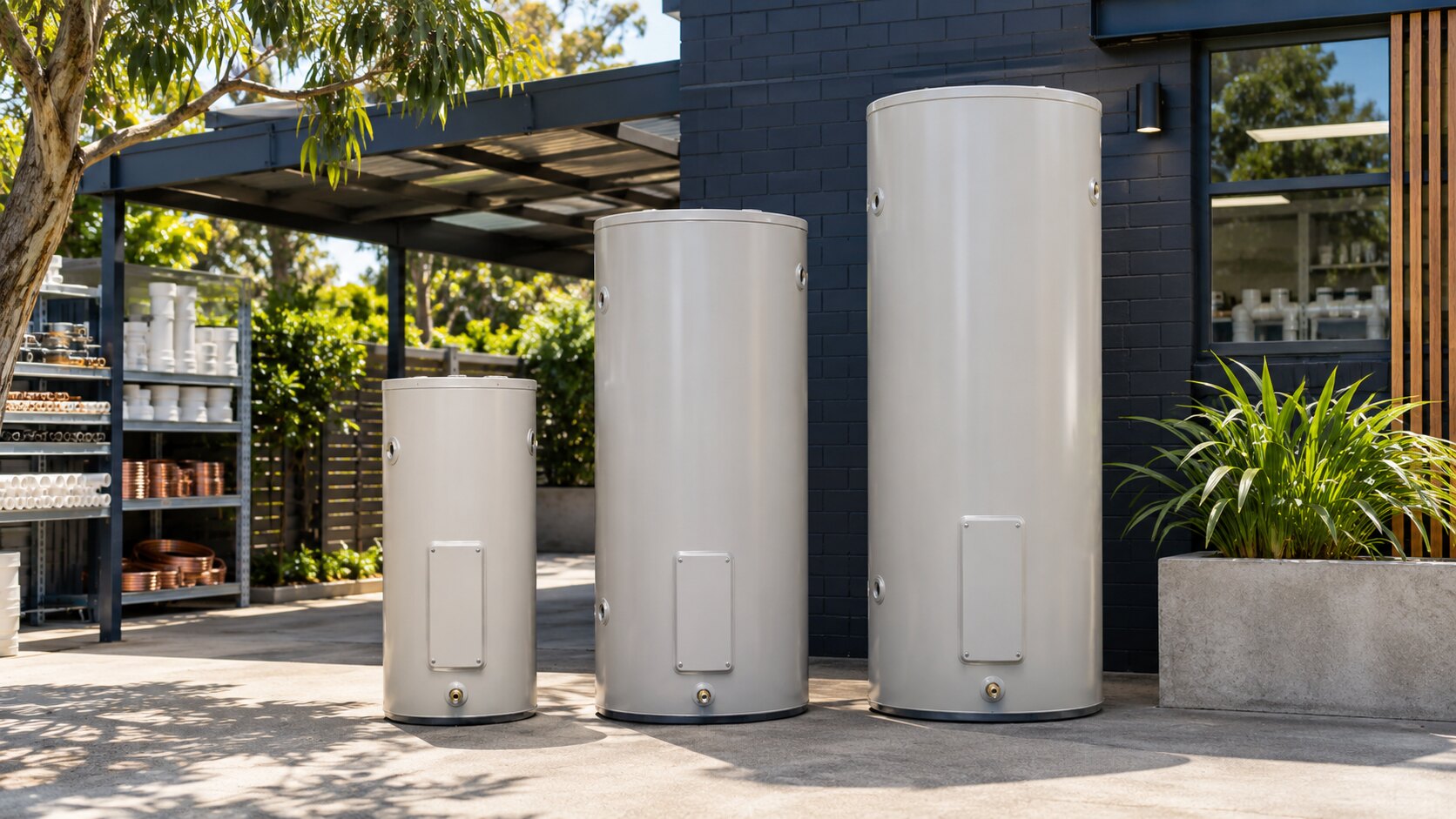
Storage litres vs flow rate, and peak demand
Match the measure to the system type, and always size for your peak — not your average.
Storage litres
A storage tank holds a fixed volume of hot water. Run it dry at peak and you wait for it to reheat. Size the litres to cover your busiest window — back-to-back morning showers — not your daily average.
Continuous flow rate
A continuous flow unit never runs out, but it can only heat so many litres per minute. Sized by flow rate (L/min), it's about how many outlets run at once — roughly 16 L/min for one bathroom, 20 for most homes, 26 for multiple bathrooms together.
Peak simultaneous use
The real test is simultaneous use: two showers plus the kitchen at 7am. Both tank size and flow rate are chosen around that peak, which is why the number of bathrooms matters as much as the number of people.
Sizing storage vs sizing continuous flow
The same home can need a very different number depending on the system — here's how each is sized.
Sizing a storage system
- Count people and your peak simultaneous draw.
- Pick litres to cover the busy window with a buffer.
- Go larger for electric off-peak, which reheats overnight.
- Too small means waiting for reheat; too big wastes standing heat.
Sizing continuous flow
- Count the outlets that run at once, not the tank.
- Match the flow rate (L/min) to that peak.
- One bathroom ~16 L/min; most homes ~20; multi-bathroom ~26.
- Under-size it and the water goes cool when demand peaks.
The simple way to get the size right
A generic chart gets you close; your home gets you exact.
Sizing charts get you close, but the accurate answer comes from your actual home — how many bathrooms, your peak usage, your system type and your gas or electrical supply. That's a two-minute conversation, and it's part of every quote we give, so you end up with a hot water system size guide built around your household rather than a generic table.
If you're still deciding between gas, electric and a heat pump before you worry about size, start with our comparison — the type changes how size is measured. Then we'll match the exact capacity to your home and the full range of hot water systems we install.
See also: comparison · hot water systems

Hot water sizing questions, answered
The questions we're asked most about sizing.
What size hot water system do I need for a family of 4?
How is hot water system size measured?
Why does my electric off-peak tank need to be bigger?
What happens if my hot water system is too small?
Is a bigger hot water system always better?
Can you recommend the right size for my home?
Get a sizing recommendation
Tell us your household and bathrooms and we'll recommend the exact size and system — itemised quote, Sydney-wide, and we come to you.