

Blog
What Size Hot Water Unit Do Sydney Families Really Need in 2026? A No-Nonsense Sizing Guide

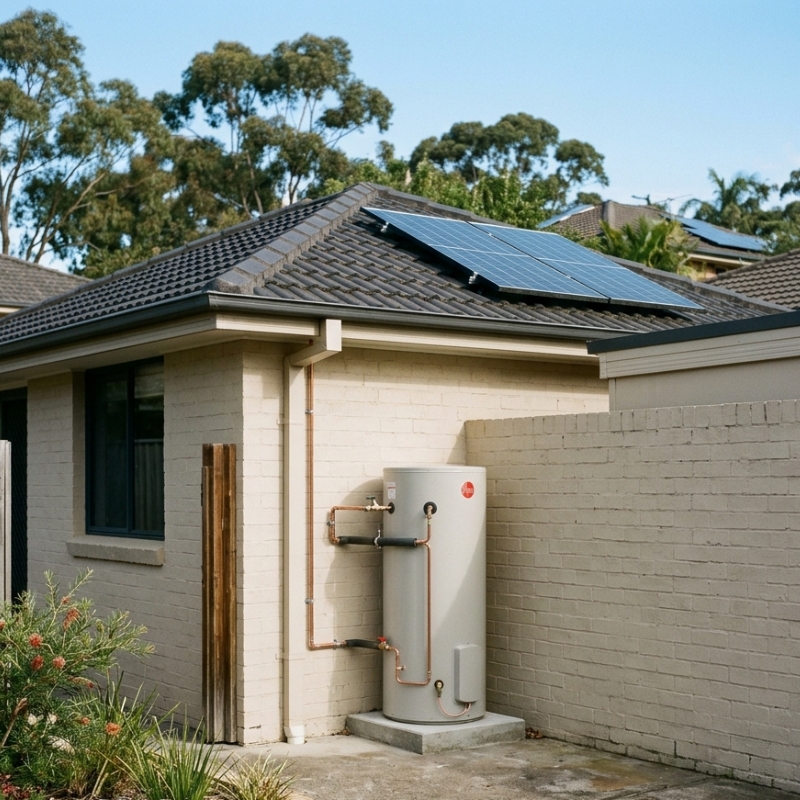
Getting the size right
Upsizing feels like the safe move. But an oversized unit quietly wastes energy every single day of its life. Skimp instead and you’ve got teenagers facing a cold shower before school. The middle ground gets a lot easier to find once you strip the decision back to two questions: how many litres of hot water does the household actually use, and how fast can the tank recover? It helps to compare models side by side while you’re working that out. The range of hot water systems shows just how much storage and instant units vary.
Why “close enough” sizing no longer cuts it
A decade ago the installer would default to a 250 L electric storage tank for a typical family and that was that. Three things have changed the sums since:
- Energy-efficiency standards keep ratcheting up, and running costs show up on the power bill in a way they didn’t used to.
- Rebates for heat pump and solar units are available federally and in NSW, though eligibility and value shift about, so check the current terms before you settle on a size.
- Household composition moves faster now. Blended families, a guest room on Airbnb, working from home. Hot water demand swings around through the week.
With power prices likely to stay high through 2026, oversizing locks in an unnecessary expense for the entire life of the system. Sizing it properly also keeps your options open for a future upgrade, such as adding a heat-pump booster to a solar array, without throwing away a perfectly good tank to do it.
Usage patterns that shape demand
Forget headcounts and gut feel. Three observable behaviours tell you far more:
Shower length
A water-efficient showerhead runs at roughly 9 L/min, and a typical shower lands somewhere near seven minutes. Call it 63 L of mixed water, of which a bit over half is drawn from the tank at 60 °C. Multiply that by the number of people showering inside a three-hour window and you have the peak you actually need to cover.
Dishwashing habits
A modern dishwasher can get through a load on as little as 12 L. Plenty of Sydneysiders still rinse saucepans under a running tap, though. Households that hand-wash pull another 20 to 30 L during the dinner rush, and that’s usually happening while the teenagers are queuing for the shower.
Laundry temperature
Cold-water detergents dominate the supermarket shelves, yet some families still run warm cycles for towels and nappies. One warm cycle takes another 15 L of 60 °C water out of the tank.
Run those numbers and the gut-feel size usually drops by one step. A family that assumed they needed 315 L often finds a 250 L high-recovery tank, or a 200 L heat pump, covers the real peak just as comfortably.
Reliable sizing methods you can trust
Plumbers talk recovery rate. Retailers talk star ratings. Homeowners need something simpler than either. The two approaches below usually land within about 10 L of each other, which is close enough for real life.
Hourly drawdown check
- Work out your busiest two-hour window, which is nearly always 6 am to 8 am or 6 pm to 8 pm.
- Count the showers, the dishwasher or sink loads, and any warm laundry cycles.
- Halve the mixed water total to get the volume of 60 °C water coming out of the tank.
Under 120 L and a 160 to 200 L storage unit, or a 20 L/min instantaneous system, will normally cope. Between 120 L and 200 L points you toward a 250 L tank or a 26 L/min instant. Above 200 L, start looking at 315 L, or at solar pre-heating to spread the load out.
Bedroom-based shortcut
For households that rarely run appliances alongside showers, the bedroom count is a decent proxy:
| Bedrooms | Likely Occupants | Storage Tank Size | Instantaneous Flow* |
| 1 to 2 | 1 to 2 people | 80 to 125 L | 16 L/min |
| 3 | 3 to 4 people | 160 to 200 L | 20 L/min |
| 4 | 4 to 5 people | 250 L | 24 L/min |
| 5+ | 5 to 7 people | 315 L | 26 to 32 L/min |
*Flow rate assumes natural gas. LPG may drop slightly.
If the two methods disagree, only lean toward the higher figure when you’re genuinely adding bedrooms in the next couple of years.
Factors unique to Sydney in 2026
Mild inlet temperature
Sydney mains water rarely drops below about 15 °C, even in July. A warmer inlet means less heating work than a colder inland city demands, which is why Sydney families can often get away with one size smaller than relatives in Canberra or Orange.
Rooftop solar everywhere
A large share of detached homes now export surplus PV most afternoons. Pair a timer-controlled element, or a heat pump set to run when solar output peaks, and a smaller tank can replenish itself cheaply before the dinner rush arrives.
Compact lot sizes
Sydney’s infill development leaves precious little side-passage real estate. A slimline 170 L tank or a wall-mounted instant unit frees up genuine space next to a standard 315 L cylinder.
Compliance: get the actual rule right
You’ll sometimes hear that keeping the tank under 250 L helps you dodge an expansion control valve. It doesn’t. An expansion control valve is required where the water heater sits on a closed system, meaning there’s a backflow prevention device, a check valve or a pressure-limiting valve on the supply. Heated water expands, and on a closed system it has nowhere to go. What triggers the valve is the configuration of your water service, not the size of the cylinder. So don’t undersize your hot water to avoid a fitting you’ll need anyway. Ask your licensed plumber what your particular installation actually calls for.
Maintenance reserves keep sizing honest
A well-sized unit depends on getting its full rated capacity. Sediment build-up, a failed sacrificial anode and thermostat creep all nibble away at the available volume after the first few years, and the tank you sized so carefully quietly stops being the tank you own. Mid-life servicing restores that lost capacity and extends the system’s life. For a step-by-step refresher partway through ownership, bookmark our anode rod maintenance guide.
Common questions answered
How much buffer should I allow for visitors?
Plan around normal life, not the Christmas rush. A 20 L safety margin covers the occasional guest. Anything beyond that is a daily running cost for hot water you almost never use.
Does an instantaneous unit really give you “unlimited” hot water?
In theory, yes. In practice, it depends on whether the gas meter, the pipework and the temperature rise capacity can all match your peak simultaneous demand. Two showers running at once will overwhelm a small 16 L/min model, so match the flow rate to how the house is actually used.
Is a heat pump slower to reheat?
It recovers more gently, yes. Modern refrigerant cycles get you roughly 70 L an hour at an ambient 20 °C. Schedule the reheat cycles outside your peak windows, and you won’t notice.
Can I upgrade element wattage instead of buying a bigger tank?
Sometimes. Swapping a 2.4 kW element for a 3.6 kW element shortens recovery by about a third. Check the wiring capacity first, though, because plenty of older circuits are limited to 15 A and a 3.6 kW element sits right on that number.
Where can I confirm energy rebate eligibility?
The NSW Climate and Energy Action site is the place to start, alongside advice on hot water efficiency. Incentives change, so check the current terms rather than relying on what a mate got last year.
Final word on right-sizing
Aim for the smallest unit that still gets you through your busiest morning. Let Sydney’s mild inlet temperature and its generous rooftop solar work in your favour, and commit to mid-life servicing so the capacity you paid for is the capacity you keep. A precisely sized system costs less to run, fits far more easily onto a dense urban block, and spares you the carbon penalty of heating water nobody uses. If you’re unsure, jot down the shower lengths and the appliance cycles for a week. Real numbers beat rules of thumb every time.