

Blog
Five Myths About Gas Hot Water Systems Sydney Homeowners Still Believe in 2026

Clearing the Air on Gas Hot Water
Sydney’s building mix has changed enormously over the past decade. Plenty of households still lean on second-hand opinions when the time comes to replace an ageing water heater, though. Outdated advice keeps doing the rounds in community Facebook groups, in strata meetings, around the kitchen table. Before you rule an upgrade in or out, it’s worth a fresh look at what’s actually true.
Modern gas hot water systems bear very little resemblance to the bulky tanks that went in during the 1990s. Burner efficiency, smart controls and better insulation have all moved, which means running costs, the emissions picture and your installation options have moved with them. These five myths are the ones that linger longest, and they cost households both money and comfort.
Running Costs Blow Out
The idea that gas costs a fortune to run has stuck around since the price spikes late last decade. Gas pricing has been genuinely volatile since, so anyone promising you a stable market is guessing. What you can rely on is how the appliance itself behaves.
A continuous-flow unit only fires the burner while a tap is actually open, which means no standby loss at all. That’s a real structural advantage over any storage tank, gas or electric, that sits there losing heat to the laundry all day. Insulated gas storage tanks have improved too, holding heat far longer than the older ones did. And the daily supply charge matters more than most people realise: if the house already runs gas for cooking or heating, that charge is spread across several appliances rather than being carried by the water heater alone. One caveat worth knowing, since it gets muddled constantly. Time-of-use tariffs are an electricity mechanism, not a gas one. If someone tells you a gas unit is cheaper because you can heat overnight on a cheap rate, they’re describing an electric controlled-load tariff, not your gas bill.
All Gas Systems Work the Same Way
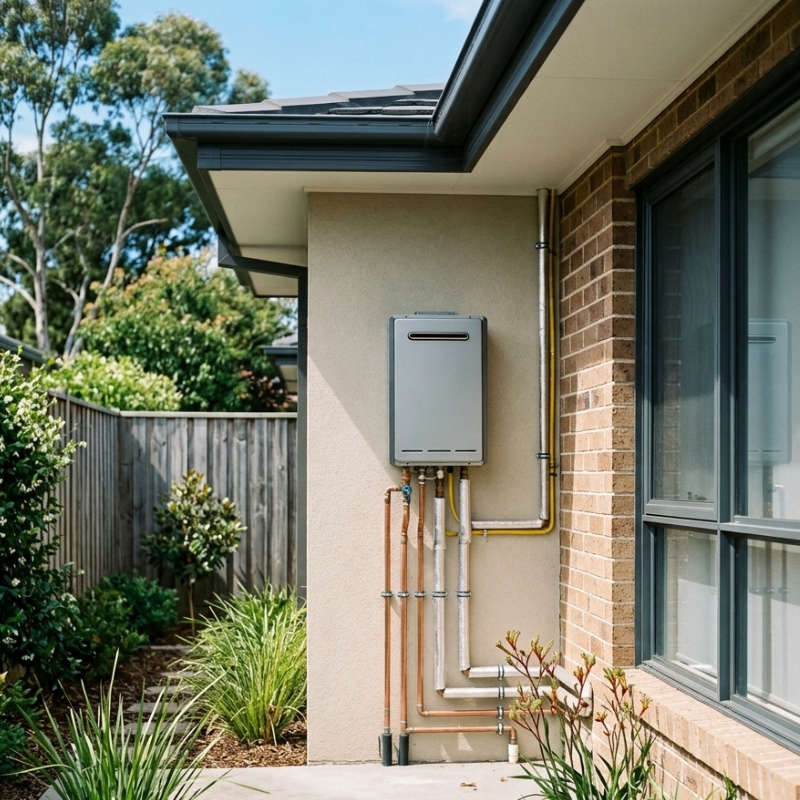
Say “gas hot water” and most people picture a single rusting tank down the side of the house. In 2026, the buyer is actually choosing between storage tanks, wall-hung continuous-flow units, solar-assisted systems with a gas booster, and combination boilers that handle space heating as well.
Each format suits a different living situation. A 170 L four-star storage tank sits comfortably beside a freestanding home on the north shore. A 26 L-per-minute continuous-flow unit is the better match for a narrow terrace in Newtown, where exterior wall space is worth more than backyard real estate. Getting this right prevents oversizing, and oversizing is what quietly inflates both the purchase price and the running cost.
For a closer look at what actually wears out inside a storage tank, our earlier article on checking your water heater’s anode rod explains how a $40 part can add years to the life of the thing.
Gas Equals High Emissions
Net zero targets have put carbon on everyone’s radar, and a lot of Sydneysiders now assume that anything electric is automatically cleaner. On today’s grid, that assumption is wrong, and it’s wrong by a wide margin.
Run the numbers. NSW grid electricity carries an emission factor of roughly 0.66 kg of CO2-e per kilowatt hour, and a gigajoule of heat is about 278 kWh. So an electric resistive tank delivering one gigajoule of hot water is responsible for something in the order of 180 kg of CO2-e. A gas continuous-flow unit delivering that same gigajoule comes in at nearer 55 to 60 kg, because burning natural gas emits a bit over 50 kg of CO2-e per gigajoule of gas and a good unit converts most of that into hot water. Roughly a third of the emissions, in other words. If your current system is an old electric resistive tank recharging through a coal-heavy evening peak, switching to gas genuinely cuts your carbon.
Be straight about the other half of this, though, because the brochures rarely are. A heat pump beats gas. It doesn’t make heat; it moves heat, delivering roughly three to four units of warmth for every unit of electricity it draws. That works out to around 50 kg of CO2-e per gigajoule on the current grid, which already edges out gas, and it improves every year as the grid cleans up. It also runs perfectly well at night and through winter, so ignore anyone who tells you a heat pump falls back on a resistive element after dark. That’s solar thermal they’re describing, which is a different product, and yes, a solar thermal system does want a booster when the sun won’t cooperate. A gas booster is a common and sensible pairing there. So if carbon is your first priority, buy a heat pump and put it on your rooftop solar. If upfront cost, apartment constraints or a dead tank on a Thursday night is the priority, gas is still a big improvement on what you’ve probably got.
Instant Units Never Run Cold
Sales brochures love the word “instant”, and it leaves some buyers expecting steam the millisecond they turn the tap. Every continuous-flow unit needs a few seconds to sense the demand, ignite the burner and push heated water down the line. What governs that lag is the distance between the appliance and your furthest bathroom, far more than the brand on the casing.
Two fixes work. A push-button pre-heat loop circulates hot water through the line before anyone steps into the shower. Or you zone the house, putting a smaller second unit near a heavily used ensuite. Neither adds much to the running cost, and both put an end to the awkward little dance of waiting for warmth on a winter morning.
Switching Is Impossible in Apartments
Body corporate bylaws and tight service ducts convince plenty of unit owners they’re stuck with whatever the builder installed. Often they aren’t. Many newer Sydney apartment blocks already carry a central gas riser for cooktops and room heaters, and re-using that line for a compact continuous-flow water heater usually comes down to coordinating a licensed plumber and getting strata approval. Not a structural rebuild.
Wall-hung units start around 350 mm wide and weigh under 20 kg, so they slot into the same laundry cupboard that held the old electric tank. The flue can terminate through an external wall or via a concentric roof vent if you’re on the top level. The steps that matter are securing a gas compliance certificate and confirming the appliance meets the block’s acoustic limits. Modern units are quiet, running at around the level of a bathroom extraction fan, but get it in writing rather than assuming.
For owners of heritage terraces with no mains gas at all, a 45 kg exchange-bottle set and a discreet regulator cage will supply hot water and the weekend barbecue without anybody trenching the courtyard.
Final Thoughts
Old beliefs cling on long after the technology has moved. Challenge these five, and you can judge gas hot water on what it does now rather than what it did in 1998. The NSW Government keeps planning and efficiency advice on its hot water systems page, which is the place to check rebates and minimum star ratings before you commit to anything, since those move around.
The end result you’re after? Fewer cold showers, a lower bill, and a system sized for the way your household actually lives rather than the way a brochure assumes it does.