

Blog
How to Choose the Right Hot Water System Size for a Sydney Household

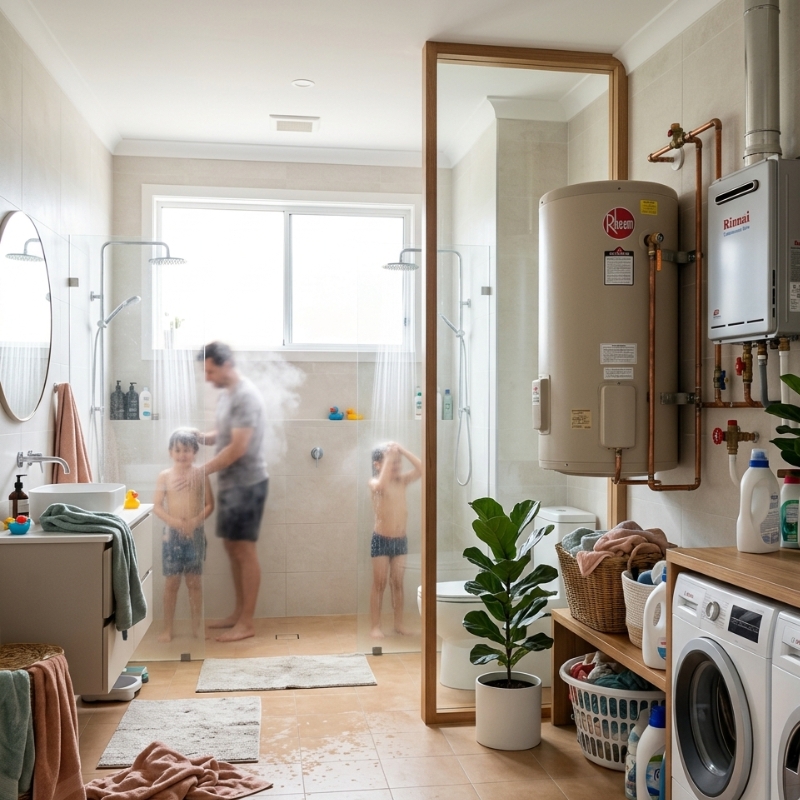
Choosing the “right size” hot water system isn’t really about litres alone. It’s about your busiest hour of the day, how many taps you run at once, and what type of system you have (storage, continuous flow, or heat pump) — whether that’s a Rheem hot water system or another brand. Get it right and hot showers stay hot. Get it wrong and you’ll either run out at the worst moment… or pay for capacity you never use.
Sydney adds its own twist: winter inlet water is colder (so systems work harder), many homes have mains pressure showers, and morning routines can be tightly stacked (school runs, gym sessions, work commutes). This guide walks you through a practical sizing method you can use at home, then shows how to apply it to common Rheem system types without turning this into a sales pitch.
Start with the real driver: your peak hot water window
Most households don’t use hot water evenly across the day. There’s usually a peak window (often 60–90 minutes) where showers overlap with handwashing, dishes, or a load of laundry.
Instead of guessing, do a quick “peak window” snapshot:
• How many showers happen back-to-back?
• Do any showers overlap (two bathrooms at once)?
• Does someone use the kitchen sink or dishwasher during showers?
• Do you run laundry (warm/hot) in the morning?
• Are there high-flow fixtures (rainfall shower, large bath)?
If your peak window is quiet (one shower at a time), you can size closer to the baseline. If your peak window stacks multiple uses, you need either more stored hot water (a bigger tank) or more instantaneous delivery (higher continuous flow capacity).
Quick answer
For most Sydney homes, sizing depends on (in order):
• Simultaneous showering (overlap)
• Shower flow rate and duration
• Number of people (as a proxy for frequency)
• System type (storage vs continuous flow vs heat pump)
• Reheating window (especially if on off-peak electricity)
Step 1: Count bathrooms, then check “overlap risk”
Bathroom count matters because it predicts overlap. But a one-bathroom home with five people can still be easy to supply if showers are staggered. Meanwhile, a two-bathroom home with two teens can burn through hot water fast if they shower at the same time.
Use this overlap risk guide:
Low overlap risk
• 1 bathroom
• 1 shower running at a time
• Short showers, standard showerhead
• Minimal morning stacking
Medium overlap risk
• 1–2 bathrooms
• Occasional overlap (two showers sometimes)
• Mix of showers + kitchen use in the same window
High overlap risk
• 2+ bathrooms with frequent overlap
• Rainfall/large showerheads or long showers
• Bath use plus showers
• Busy morning routine for multiple people
If you’re medium or high overlap, you’ll usually be happier sizing one step up (or choosing a system type that handles overlap better).
Q&A: Is bathroom count more important than household size?
Bathroom count predicts whether hot water use overlaps. Household size predicts how often the peak window happens. If you’ve got two bathrooms and morning overlap is common, that typically drives sizing more than headcount alone.
Step 2: Decide your system type first (because sizing “units” changes)
Sizing means different things depending on system type:
• Storage systems are mostly sized in litres (L)
• Continuous flow systems are mostly sized in litres per minute (L/min) of hot water delivery under realistic conditions
• Heat pumps are still sized in litres, but they generally prefer a larger tank because reheating can be slower than electric resistance
When people compare a “160L tank” to a “26L/min continuous flow,” they’re comparing apples to oranges. The right question is: will it meet your peak window without a temperature drop or running out?
Step 3: Use a practical sizing baseline (then adjust)
These are sensible starting points for many Sydney households with typical showering habits. They’re not the final answer yet—your overlap and fixtures will adjust the outcome.
Storage tank baseline (electric or gas storage)
• 1–2 people: often 125–160L
• 3–4 people: often 160–250L
• 5+ people: often 250–400L (or consider alternative approaches depending on overlap)
Continuous flow baseline (gas instantaneous)
• 1 bathroom, low overlap: around a 20–22L/min class may be sufficient
• 1–2 bathrooms, medium overlap: around a 24–26L/min class
• 2 bathrooms, high overlap: around a 26–30L/min class (and/or flow management)
Those ranges are intentionally broad because real-world performance depends on inlet water temperature, desired outlet temperature, and how many hot taps run at once.
Q&A: What if I’m between sizes?
If you’re between sizes, decide based on comfort risk. If you have frequent overlap, long showers, or winter “cold water creep,” sizing up tends to reduce frustration. If you live alone or have low overlap, the smaller option is often enough.
Step 4: Adjust for Sydney winter and your shower style
Two common reasons Sydney households feel “undersized”:
- Winter inlet water is colder
Colder incoming water means the system needs more energy (and often more time) to raise the temperature, and continuous flow units may deliver less “effective” hot water at your preferred shower temperature. - Modern showers can be thirsty
Mains pressure plus a higher-flow showerhead can raise demand quickly. Even if the tank is “big enough on paper,” a long, high-flow shower can use stored hot water faster than you expect.
Quick self-check
During winter, do you notice:
• Hot water runs out faster?
• Temperature dips when a second tap turns on?
• You avoid doing dishes while someone showers?
If yes, you may be sized too close to baseline for your real peak window.
Step 5: Match sizing logic to the Rheem system type you’re considering
Rheem offers multiple system types, so the best way to choose is to match your household routine to the category that naturally handles it. If you want to compare sizes across different system types without getting lost in specs, start by browsing the Rheem hot water system range and match each option to your household’s peak shower overlap.
Rheem electric storage: litres matter, plus reheating window
Electric storage can be a great fit where showers are mostly sequential, especially in 1-bathroom homes. But it’s sensitive to reheating time, and that matters a lot if you’re on off-peak electricity.
What to consider:
• If your household uses most hot water in the morning, a tank that reheats slowly can feel “small,” even if its litre rating looks fine.
• If you’re on off-peak and you drain the tank, you may have limited recharge until the next heating window.
• If overlap is high, moving from 160L to 250L can feel like a huge upgrade in comfort.
Practical rule:
• Medium overlap: consider sizing one step up from baseline.
• High overlap on a single tank: consider a larger tank, or a system type that handles simultaneous use better.
Q&A: Why do we run out in the morning but not at night?
Morning use is stacked. Night use is usually spread out. Sizing should match your busiest routine, not your average day.
Rheem gas storage: think recovery, not just litres
Gas storage often “feels bigger” than the same litre size electric tank because it can recover faster (depending on model and setup). For busy households, faster recovery can reduce the risk of running out during peak times.
What to consider:
• A slightly smaller tank with strong recovery can outperform a larger tank with slower reheating.
• Peak overlap still matters: two showers at once can drain stored hot water faster than recovery can replace it.
Practical rule:
• If your peak is intense (multiple showers close together), prioritise both buffer (tank size) and recovery ability—don’t choose on litres alone.
Rheem continuous flow: size for overlap, not just “one shower”
Continuous flow is often chosen to reduce “running out” anxiety, but it has a maximum heating capacity at any given moment. If your household runs multiple hot taps at once, you need the L/min class that matches that reality.
What to consider:
• Two showers at once plus a kitchen tap can cause a temperature drop if the unit is undersized for simultaneous demand.
• In winter, the same unit may deliver less “effective” hot water at your preferred shower temperature.
For households where two showers sometimes run at once, it helps to shortlist a few Rheem hot water options and then sanity-check them against your busiest 60–90 minutes (weekday mornings are usually the real test).
Practical rule:
• If you frequently run two showers at once, size for that scenario. Don’t size only for “typical” single-shower use.
Q&A: How do I know if my continuous flow is undersized?
If the shower temperature noticeably drops when another hot tap turns on (and your plumbing is otherwise healthy), that’s a common sign the unit is being pushed beyond its comfortable simultaneous capacity.
Rheem heat pumps: plan a little bigger for comfort
Heat pumps are efficient, but they often reheat more slowly than electric resistance systems. That means tank size becomes even more important when you have a tight peak window.
What to consider:
• A heat pump with a larger tank can handle morning peaks better, because it has more stored hot water ready to go.
• Recovery is still important, but the “buffer” (tank size) is the comfort-maker.
Practical rule:
• If your baseline suggests 160–250L, it’s often safer to lean toward the upper end if you have medium/high overlap.
If you’re still unsure whether you need more stored litres or more continuous-flow capacity, the Rheem hot water system guide is a handy reference point to compare categories while you apply the sizing steps in this article.
The easiest sizing method: a 10-minute peak-demand worksheet
Here’s a simple way to translate your routine into a decision, without needing technical charts.
1) Write down your peak window uses
Example peak window (7:00–8:00 am):
• Shower 1: 8 minutes
• Shower 2: 10 minutes
• Kitchen use: kettle fill + dishes (hot tap a few minutes)
• Bathroom sink use: quick handwashing
2) Mark overlap moments
Do any of these occur at the same time?
• Two showers overlap
• Shower + dishwasher fill
• Shower + kitchen sink
Overlap is the multiplier that drives sizing.
3) Decide which failure you’re trying to avoid
Choose the pain point you want to eliminate:
• Running out of stored hot water (storage systems)
• Temperature dip when a second tap turns on (continuous flow)
• Long recovery before hot water returns (any system, but especially off-peak/heat pump)
Your system type and size should be selected to avoid the failure you actually experience.
Q&A: Is it better to oversize “just in case”?
Only if the “case” is real. If you’re planning a renovation, adding a bathroom, or your kids are entering the teen-shower era, sizing up can prevent an early upgrade. But if your overlap is genuinely low, oversizing may just add cost without improving comfort.
Common sizing mistakes Sydney households make
Mistake 1: Counting people but ignoring bathrooms
A four-person, one-bathroom home with staggered showers can thrive on a moderate tank. A three-person, two-bathroom home with overlap can struggle on the same size. Bathrooms predict overlap; people predict frequency.
Mistake 2: Forgetting off-peak limits
If you’re on off-peak electricity and you drain the tank early, it may not reheat when you want it to. That can feel like a sizing problem even when the tank capacity is technically adequate.
Mistake 3: Ignoring shower flow rate changes
A showerhead swap can change demand dramatically. If you’ve upgraded to a high-flow or “luxury” shower experience, your old sizing assumptions may no longer hold.
Mistake 4: Expecting continuous flow to power everything at once
Continuous flow is excellent, but it still has a ceiling. If your household runs multiple hot outlets simultaneously, you must size accordingly, or you’ll notice temperature stability issues.
Safety and temperature control: what to know
In many homes, the water stored in a tank may be hotter than what’s delivered to bathroom taps, because temperature control devices can limit outlet temperature for safety. That’s one reason households can report different “hot water performance” from similar systems.
For an authoritative overview of temperature control device requirements and why delivery temperature matters, the NSW Government has guidance here: NSW Government temperature control device installation requirements.
Sydney household scenarios (so you can self-identify)
Scenario 1: Apartment, 1 bathroom, 1–2 people
Likely pattern:
• Single shower at a time
• Low overlap risk
Sizing approach:
• Start at baseline and only size up if showers are long or you stack laundry/dishes in peak time.
Scenario 2: Terrace/semi, 1–2 bathrooms, 3–4 people
Likely pattern:
• Morning peak stacking
• Occasional overlap
Sizing approach:
• Decide whether two showers overlap more than “rarely.” If it happens weekly, size as if it’s normal.
Scenario 3: Family home, 2 bathrooms, 4–5 people
Likely pattern:
• Regular overlap
• Higher shower frequency
Sizing approach:
• Choose a storage buffer or continuous flow capacity that comfortably handles two showers at once, not just one.
Scenario 4: Larger home, 3 bathrooms, 5+ people
Likely pattern:
• Frequent overlap
• High peak demand
Sizing approach:
• Map peak overlap honestly. If multiple bathrooms run simultaneously, size for that reality, or plan to manage flow.
When your symptoms tell you the size is wrong
Hot water runs out quickly
Often points to:
• Storage capacity too small for your peak window
• Peak overlap more intense than assumed
• Reheating window limits (off-peak)
• Longer/higher-flow showers than before
Temperature drops when another tap turns on
Often points to:
• Continuous flow capacity not sized for overlap
• Flow demand exceeding heating capacity at that moment
It takes ages to “come back” after morning showers
Often points to:
• Recovery too slow for your routine
• Heat pump/electric storage needing more buffer
• Controls/settings not aligned with usage patterns
FAQ
What size hot water system do I need for a family of 4 in Sydney?
Many families of four land in the mid range, but overlap decides the final size. If showers are sequential, you can stay near baseline. If two showers overlap or you run kitchen/laundry in the same window, size up or ensure continuous flow capacity matches real simultaneous use.
What size hot water tank do I need for two bathrooms?
Two bathrooms often means overlap risk. If two showers run at once even occasionally, sizing one step above baseline tends to improve comfort and reduce “ran out” moments.
Is continuous flow better than storage for a busy household?
It can be, especially if you size it for overlap. Storage can still be excellent if tank size and recovery suit your peak window. The “better” choice is the one that handles your busiest routine reliably.
Do heat pumps need bigger tanks?
They often benefit from a bigger buffer because reheating can be slower. If your household has a tight morning peak, leaning toward a larger tank can reduce frustration.
Can a showerhead upgrade force me to upsize?
Yes. If you increase flow, you increase demand. A system that was right-sized before might suddenly feel undersized.
What if we’re planning a renovation or adding a bathroom?
Treat that as future overlap. If you expect more simultaneous showers, it’s sensible to size for the future now if budget and space allow.